
Obligations acc. Extended Producer Responsibility in the EU
In many countries, labeling and information requirements have been implemented in recent years that must be observed by distributors (manufacturers, distributors and importers). Labeling and information requirements are there to inform the end user about materials, ingredients and disposal so that material flows can be directed to their recycling and the amount of unusable residual waste is minimized. This is intended to preserve resources and prevent environmentally harmful disposal and low-grade recycling of waste.
Labeling obligations
Are mostly symbols or pictograms and must be displayed on products and/or product packaging.
These include, for example:
- CE Mark
- Energylabel
- Crossed out garbage can
Also known are:
- Green Dot
- TRIMAN & Sorting information
- Sorting note in Italian acc. CONAI
- UKCA Label
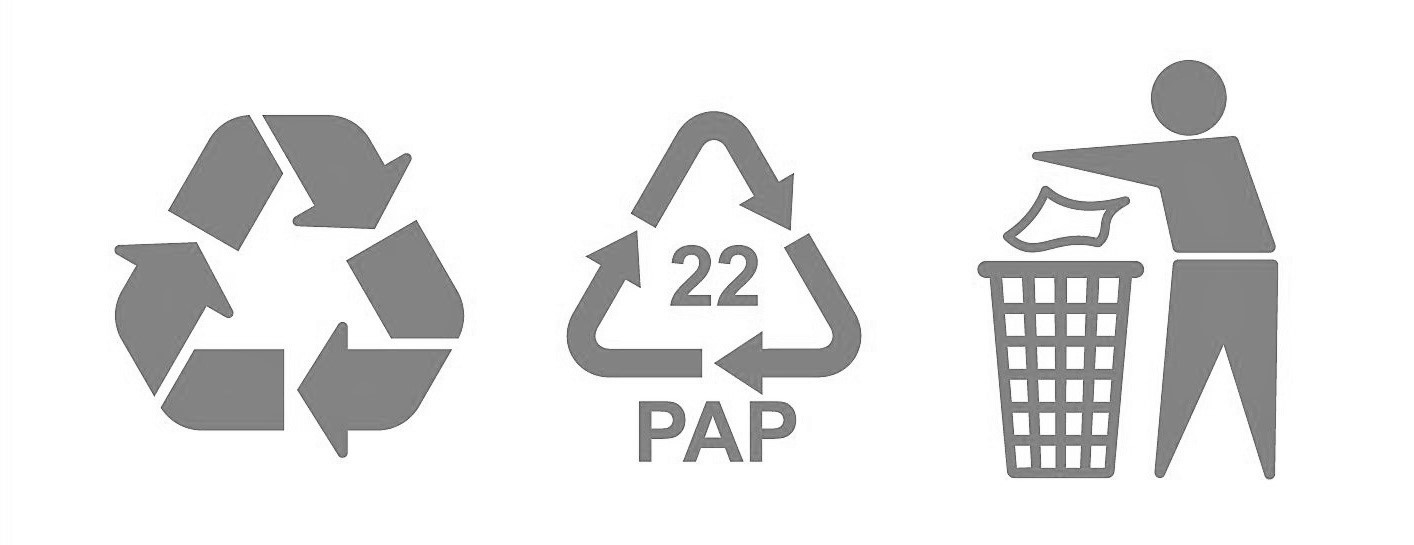
- Tidyman
- Moebius strip
- Material code
- Recycled content
- Recyclability
- Content of substances harmful to the environment and health
Information obligations
Are mostly symbols and/or texts and alphanumeric codes. They must be visible on accompanying documents, invoices, delivery bills and the website.
These include, for example:
- National Registration IDs
- e.g. also the UID/IDU number in France
- Repairability index
- Return and disposal instructions
- Sorting Information
- Contact and address data of the distributor
- Paid contributions to collection and recycling
- Battery capacity
Is there an EU-wide solution?
No, but there is a minimum standard: throughout the EU, the relevant EU directives on the labeling of electrical appliances, batteries and packaging can be used. These apply in every country and may not be prohibited in any. If you apply them, you have already taken the first step and met the general minimum requirements.
France, Poland, Germany and Italy are the countries with the most extensive requirements. You should definitely have them checked to see if you are meeting them.
What must be on where?
The labeling obligations must be recognizable on all products, their packaging and their accompanying documents. For each type of product, whether textile, packaging, electrical appliance, furniture, mattress, chemical, etc., there are different obligations. These vary according to product type and country, so there is no universal solution. In addition, the requirements change every year. So you have to check again and again whether your labels and information are still up to date, or have been revised in the meantime – maybe even banned!
With regard to all national obligations, a detailed examination of the product, sales market and distribution channels is required, as well as deadlines and requirements with regard to the design, so that there are no breaches of obligations or misunderstandings. An individual check is therefore a prerequisite for achieving 100% legal compliance.
FAQ: Key questions on EPR labelling & compliance in Italy
Italy maintains several separate registries, all of which require mandatory registration:
- RAEE Registry (RAEE) – Electrical and Electronic Equipment, registered with the Chamber of Commerce through the RAEE Coordination Center
- Registro Pile e Accumulatori (RPA) – Batteries and Rechargeable Batteries, also at the Chamber of Commerce
- CONAI – Packaging (consortium; not a government registry, but membership is effectively mandatory for distributors)
Products may not be sold in Italy without a valid registration number. Marketplaces actively verify these numbers.
Fully in effect as of January 1, 2023: Each packaging component must be labeled individually with:
- Material code according to Decision 97/129/EC (e.g., PAP 20 for corrugated cardboard, PET 1 for PET, ALU 41 for aluminum)
- Waste separation and disposal instructions in Italian, typically “Raccolta differenziata” with a list of materials
- Note: Please follow local waste disposal regulations (Check the regulations in your municipality)
The marking may be printed, embossed, or affixed as a label. Inventory produced before January 1, 2023, may be sold provided it is properly documented. Violations are subject to fines of €5,200–40,000 per violation.
Limited. CONAI’s free online tool, E-tichetta, generates compliant label layouts with material codes and required information. However, it does not verify whether the packaging composition is correctly declared—that responsibility remains with the manufacturer.
For complex multi-component packaging (e.g., pump dispensers with a metal spring and a PE body), a preliminary technical review is advisable because the tool does not assess the separability of the components.
RAEE and RPA: 4–8 weeks from submission of the complete documentation. The main bottleneck is usually the notarized power of attorney with an apostille for the Italian representative—this lead time (often 2–3 weeks for the notary appointment and apostille) must be factored into the schedule.
CONAI: Membership within 1–2 weeks, followed by ongoing volume reports.
Realistic profit margins for a medium-sized importer:
- WEEE Authorized Representative: €1,500–3,500 per year
- WEEE Take-Back System Fee: volume-based; small product lines starting at €500 per year
- RPA Authorized Representative and System: €800–2,000 per year
- CONAI membership fee: one-time fee of 50 € + volume-based fees (Contributo Ambientale CONAI, CAC) per material
- One-time notary and apostille fees: €300–800
Total for the first year: typically €4,000–8,000; significantly reduced starting in the second year.
- WEEE: Annual volume reporting via the system, plus quarterly data submitted to the WEEE Coordination Office
- RPA: Annual Report to ISPRA on Marketing Volumes
- CONAI: Monthly or quarterly volume reporting, depending on the material category and annual volume
Deadlines are strict. Late submissions trigger automatic late fees, and repeated failures to meet deadlines result in exclusion from the system—leading to a sales ban.
- Power of attorney without an apostille—will be rejected by the authorities, causing a delay of several weeks
- Labeling only on the outer carton, not on the inner packaging—Decree 116 requires labeling on every component
- Underestimation of CAC fees for plastic packaging—these have risen sharply since 2024
- Late WEEE reporting in Q1 after the end of the fiscal year—the most common reason for fines